Primary Intended Audience
Prepared by the Center for Humanities Communication (CHC), this background portfolio on the humanities and humanities communication is a start on an informational resource equivalent to the CHC’s “Background on Science Communication.” It is designed to provide a quick sense of the scope and robustness of the humanities and (though less developed than the far more evolved and professionalized field of science communication) “humanities communication.”
In the future, this background portfolio will evolve into (or be incorporated in) the CHC’s planned Talking Points Toolbox for the humanities. (See proposal for the Talking Points Toolbox.)
Table of Contents
Definitions of the Humanities
Below is a sample of definitions of the “humanities,” ranging from academic to public understandings of the term. See also references in the Center for Humanities Communication’s Bibliography under What Are Humanities?)
Note: Unlike the definitions of “science communication” included in the CHC’s “Background on Science Communication,” the below are not definitions of “humanities communication” but more broadly of the “humanities.” Not yet as developed or professionally recognized as its equivalent in the sciences, “humanities communication” is still an emerging field whose definitions are evolving.
Definitions of the Academic Humanities
U.S. Congress. “National Foundation on the Arts and the Humanities Act of 1965 (P.L. 89-209).” (The act that created the NEH and NEA) 1965. https://www.neh.gov/about/history/national-foundation-arts-and-humanities-act-1965-pl-89-209.
“The term ‘humanities’ includes, but is not limited to, the study and interpretation of the following: language, both modern and classical; linguistics; literature; history; jurisprudence; philosophy; archaeology; comparative religion; ethics; the history, criticism and theory of the arts; those aspects of social sciences which have humanistic content and employ humanistic methods; and the study and application of the humanities to the human environment with particular attention to reflecting our diverse heritage, traditions, and history and to the relevance of the humanities to the current conditions of national life.”
American Academy of Arts and Sciences, Commission on the Humanities and Social Sciences. “The Heart of the Matter.” Cambridge, MA, 2013: 17. https://www.amacad.org/publication/heart-matter.
“The humanities—including the study of languages, literature, history, jurisprudence, philosophy, comparative religion, ethics, and the arts—are disciplines of memory and imagination, telling us where we have been and helping us envision where we are going.”
The British Academy for Humanities & Social Sciences, “Press Pack,” 2015.
“Research stemming from a detailed understanding of human behaviour, economies, cultures and societies can dramatically redefine the crucial decisions we need to make. These decisions may involve the future direction of our economy, ways of broadening and strengthening education provision at all levels, or how we deal with the effects of climate or constitutional change… The humanities and social sciences teach us how people have created their world, and how they in turn are created by it.”
Bod, Rens. A New History of the Humanities: The Search for Principles and Patterns from Antiquity to the Present. Translated by Lynn Richards. Oxford: Oxford University Press, 2013: 1.
“What are the humanities? It is like the notion of ‘time’ in St. Augustine: if you don’t ask, we know, but if you ask, we are left empty handed. Since the nineteenth century the humanities have generally been defined as the disciplines that investigate the expressions of the human mind. Such expressions include language, music, art, literature, theatre, and poetry. Thus, philology, linguistics, musicology, art history, literary studies, and theatre studies all belong to the realm of the humanities.”
Small, Helen. The Value of the Humanities. The Literary Agenda Series. Oxford: Oxford University Press, 2014: 57.
The humanities study the meaning-making practices of human culture, past and present, focusing on interpretation and critical evaluation, primarily in terms of the individual response and with an interminable element of subjectivity.
Drees, Willem B. What Are the Humanities For? Cambridge: Cambridge University Press, 2021: 12.
Humanities are academic disciplines in which humans seek understanding of human self-understandings and self-expressions and of the ways in which people thereby construct and experience the world they live in.
Wikipedia, “Humanities,” June 4, 2024.
Humanities are academic disciplines that study aspects of human society and culture, including certain fundamental questions asked by humans. During the Renaissance, the term ‘humanities’ referred to the study of classical literature and language, as opposed to the study of religion or ‘divinity.’ The study of the humanities was a key part of the secular curriculum in universities at the time. Today, the humanities are more frequently defined as any fields of study outside of natural sciences, social sciences, formal sciences (like mathematics), and applied sciences (or professional training). They use methods that are primarily critical, speculative, or interpretative and have a significant historical element—as distinguished from the mainly empirical approaches of science.
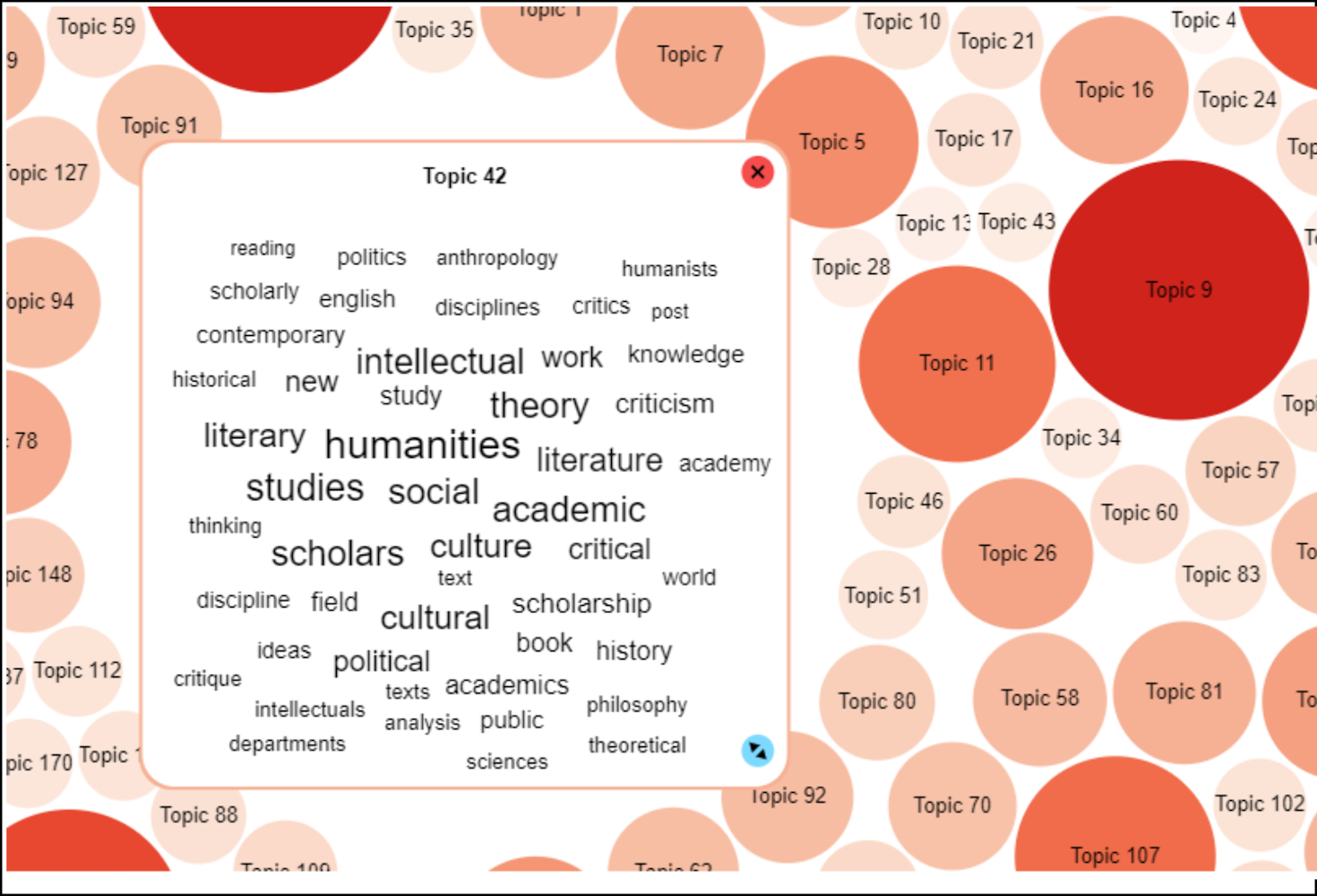
WhatEvery1Says (WE1S) Project. “Home Page,” 2022. https://we1s.ucsb.edu/.
Definitions of the “Public Humanities”
Berkowitz, Carin, and Matthew Gibson. “Reframing the Public Humanities: The Tensions, Challenges & Potentials of a More Expansive Endeavor.” Daedalus 151, no. 3 (August 22, 2022): 73. https://doi.org/10.1162/daed_a_01929.
While these are all forms of the public humanities that come from the academy or emanate from within humanities councils, as we mentioned before, the best versions of the public humanities-the real “grassroots” humanities-are created by publics, not merely for them. Too often when scholars have talked about public versions of disciplines they have meant merely that their wisdom would be understood by or distributed within a public. In its more radical form, however, the public humanities ask instead for the academy to give up its ownership of knowledge creation….
Ellison, Julie. “The New Public Humanists.” PMLA 128, no. 2 (2013): 289–98. https://nuceg.files.wordpress.com/2013/09/julie-ellison-on-public-humanities.pdf.
Since the late 1990s, therefore, a diff erent form of the public humanities has begun to take hold in colleges and universities. If this more recent model does not conform to the tradition of professional education in pub- lic history or museology programs, it is not antithetical to it, either. e new public hu- manities do not exclude nonacademic careers as a graduate student goal—far from it. But, for the most part, faculty members, graduate students, and undergraduates in the humani- ties who follow this approach are working across the academic- public boundary from the campus side. They are building a mod- est infrastructure for new public humanities with public scholarship at their core.
What the Public Thinks the Humanities Are
Humanities Indicators. “The Humanities in American Life: Insights from a 2019 Survey of the Public’s Attitudes & Engagement.” Cambridge, MA: American Academy of Arts & Sciences, 2020: 3-4. https://www.amacad.org/publication/humanities-american-life.
For the purposes of this study, the term humanities encompassed more than the academic disciplines associated with the field. The term also includes a wide array of activities in which Americans engage as part of their personal and work lives, such as: early childhood reading; K–12 and higher education in humanities subjects; later-in-life engagement with the humanities through books, the internet, television, and cultural institutions; and descriptive writing and technical reading on the job.
Early exploratory work for the survey proved instructive, as it suggested the substantial presence of such activities and skills in the everyday lives of Americans, but also that Americans have strikingly diverse conceptions of the humanities, many of which are at odds with those embraced by insiders in the humanities community.
As part of the survey development process, 175 American adults were polled about their understanding of the term humanities. A considerable share connected the term to activities and notions that have little connection to the field (ranging from “giving blood” to an observation that “science is about humans, right?”). Perhaps most prominent of all, respondents connected the humanities to the fine and performing arts, as shown in a word cloud of the responses.
Based on these findings, the survey was structured to ask first about the what and where of humanities activities (such as reading at home, thinking about an ethical choice, or visiting a history museum) without employing the term humanities. The term was then concretized for respondents by pointing them back to the earlier practices and also providing a definition rooted in some of the better-known disciplines (“studying or participating in activities related to literature, languages, history, and philosophy”). Only then were respondents asked about their opinions of the field.

—Liu, Alan, Abigail Droge, Scott Kleinman, Lindsay Thomas, Dan C. Baciu, and Jeremy Douglass. “What Everyone Says: Public Perceptions of the Humanities in the Media.” Daedalus 151, no. 3 (2022): 19–39. https://doi.org/10.1162/DAED_a_01926.
Our corpus shows, for example, that the humanities are threaded throughout people’s experiences as part of the ordinary happenings of life. Embedded in the everyday, event-oriented, and local, the humanities participate in a constant stream of cultural activity and community gatherings, appearing in discourse about local arts festivals, bookstore readings, museum exhibits, and campus events.
The humanities also index the “ordinary” in the different sense of fundamental events of living and dying. Wilcoxon test and keyphrase extraction data show that articles containing “humanities” from top-circulation newspapers, for example, are characterized in part by family-oriented language such as “wife,” “mother,” “father,” “son,” “daughter,” “children,” and “parents” as well as life-event verbs such as “born,” “married,” and “died,” often indicating the frequency of obituaries and wedding announcements. Mentions of the humanities disproportionately accompany such genres representing momentous personal occasions when families for reasons of their own find it important that a loved one’s life be crowned by citing a humanities degree, award, or organization. Notably, this kind of everydayness appears to be more pronounced for the humanities than for the sciences. While we found in our corpus that documents mentioning the sciences far outnumber those mentioning the humanities (by a ratio of about twenty-five to one), the numbers of obituaries mentioning the sciences and the humanities are relatively even. This finding suggests just how widely humanities-related organizations and activities are deposited throughout the social body. Genres that are often overlooked in discussions of the humanities– event listings, marriage announcements, and obituaries–became central for us as a previously unrecognized milieu of the powerful, widely distributed impact of the humanities.
Humanities Communicator Careers & Positions
CHC’s Proposal for a Census of Humanities Communicator Positions
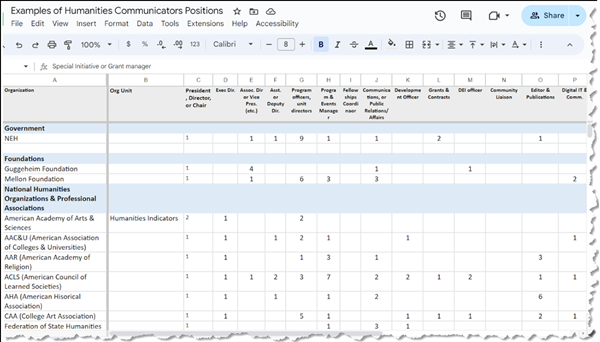
The following screenshot links to a Google Sheet started by the CHC to track examples of humanities communicator positions (identified in the column headings) in different kinds of organizations (identified in rows).
Kinds of positions include roles ranging from leadership to entry-level positions that involve communicating the humanities to a wider audience. (That is, these are not “humanities positions” per se but specifically “humanities communicator positions.”) The proportion of “humanities communication” work in each role requires more study (e.g., by polling or interviewing organizaitions).
Kinds of organizations, to start with, include: government, foundations, national humanities organizations, humanities professional associations, state humanities organizations (such as humanities councils), local humanities organizations (such as humanities centers, community organizations), university and college agencies (e.g., staff in humanities division), publishers, etc. The CHC hopes that with funds to continue such a tracking project it can in future canvass a wider spectrum of organizations in a systematic way.
Currently, this spreadsheet represents just the start of an initial, provisional, and unsystematic study (with unchecked and unverified numbers of positions at each organization found simply by browsing organizational websites and org charts).